What if your menstrual cycle is less about dates on a calendar and more about hormones talking to each other? And if these periodic conversations are carefully coordinated, then what can put them out of sync?
These are questions that I’ve been tiptoeing around for the last couple years while on this journey to better understand my body and cycle.
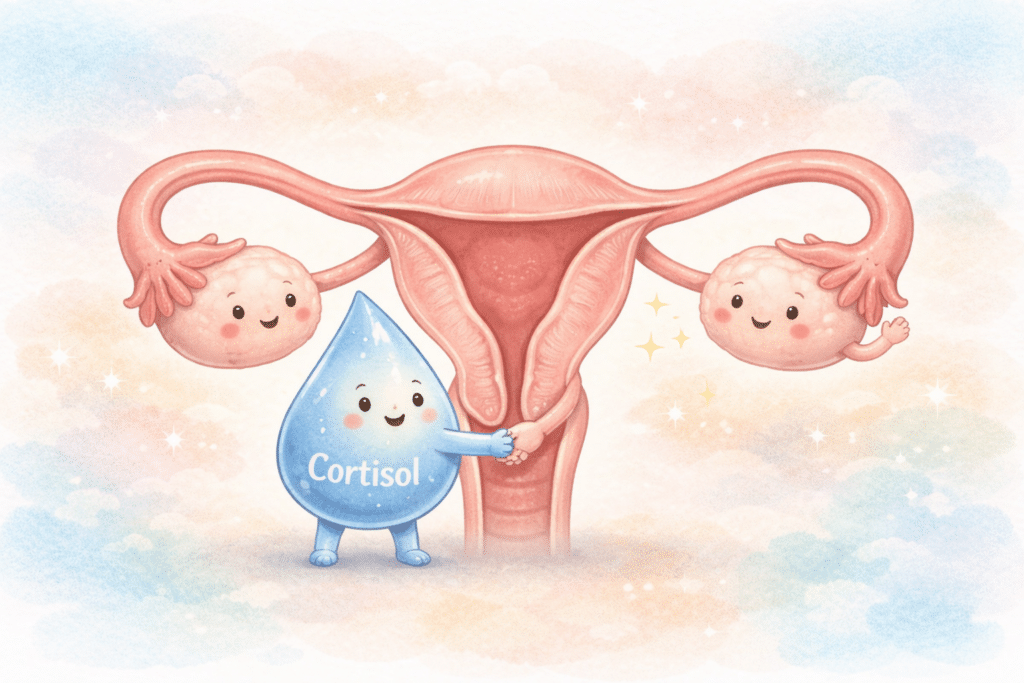
Think of your hormones like they are in a group chat. First, the brain kicks things off with a GnRH message. This prompts LH and FSH to reply. Then, the ovaries respond by sending estrogen and progesterone updates, but cortisol is the friend who keeps blowing up the chat with ALL CAPS emergency texts. When that happens all the time, the group stops talking about ovulation and starts focusing only on the “crisis” response. As a result, the cycle gets delayed, skipped, and/or chaotic.
Luteinizing hormone (LH) and follicle-stimulating hormone (FSH) are hormones that help control the menstrual cycle and ovulation. At the start of the cycle, the brain releases gonadotropin-releasing hormone (GnRH). This causes FSH production to help eggs in the ovaries grow while LH production helps those eggs produce estrogen. As estrogen levels rise, they briefly slow these hormones down but once estrogen gets high enough, it triggers a sudden spike in LH. This LH surge releases an egg from the ovary (ovulation). After ovulation, LH helps the ovary make progesterone to prepare the uterus for pregnancy. If pregnancy doesn’t happen, hormone levels drop, and the cycle starts over [1].
Cortisol and reproductive hormones are closely linked through the body’s stress response. Cortisol is released by the adrenal glands as part of the hypothalamic-pituitary-adrenal (HPA) axis during physical or psychological stress. On the other hand, reproductive hormones, such as estrogen and progesterone, are regulated by the hypothalamic-pituitary-gonadal (HPG) axis. Note that both hormone pathways start at the hypothalamus and pituitary, glands which are located in the brain [1,2].
When cortisol levels are chronically elevated, they can suppress the release of GnRH from the hypothalamus and thus inhibit LH and FSH. Reduced LH and FSH means reduced release of estrogen and progesterone [2,3]. This suppression can result in a disrupted menstrual cycle, ovulation to not occur (anovulation), and decreased libido [3,4]. A disrupted menstrual cycle can adversely affect mood and energy levels, as the hormone cycle no longer syncs with the body [3,5].
Long periods of stress mean elevated cortisol, perpetuating disruptions in the hormone cycle [5]. This can look like missed or late periods, persistent fatigue despite getting 8+ hours of sleep, low mood, irritability, and increased anxiety [3,4]. A new cycle is reinforced: stress disrupts hormonal signaling, these disruptions strain the body further, and cortisol remains chronically high, causing further stress that keeps the disruption cycle going.
What can you do to check your hormone levels?
You can start by working with a healthcare provider (primary care, OB-GYN, or endocrinologist), who can order blood tests for hormones like cortisol, LH, FSH, estrogen, and progesterone. Timing matters: LH, FSH, estrogen, and progesterone are often checked on specific cycle days (commonly day 3 or day 21 in a typical cycle), so tracking your cycle will be extremely useful. If access to a provider is limited, reputable at-home lab services can measure cortisol and some reproductive hormones, though results should ideally be reviewed with a clinician. Keeping a symptom log (sleep quality, level of stress, cycle regularity, mood, and energy), alongside lab results, can also help identify patterns and guide our approach [6,7].
What I like to do to support my hormone balance?
I have not at all been perfect about this, but I’m still figuring out what works and doesn’t work for me. I’ve switched over to having coffee after breakfast and not first thing in the morning on an empty stomach. It is natural to have some cortisol in your system, especially the first 1-2 hours after waking up [8]. Before adding more cortisol to my system via caffeine, I’ve been trying to make use of the alertness and attention that come with my natural levels of cortisol at wakefulness and with morning sunlight exposure. Regular moderate exercise and getting at least 8 hours of quality sleep also support stress reduction and consequently lower cortisol and maintain the integrity of the reproductive hormone cycle [8].
Getting 8 hours of sleep may not necessarily equate to 8 hours of quality sleep [9]. I, myself, am working on improving sleep quality by keeping the room I sleep in cooler, avoiding blue-light from the phone, laptop, and TV at least 30-40mins before getting in bed, and trying to go to bed at the same time each day [9]. At times, keeping consistency in this routine gets difficult, but even making it work a couple nights each week can be beneficial.
What small change could you make today to support your hormonal health?
References
- Bäckström, C. T., McNeilly, A. S., Leask, R. M., & Baird, D. T. (1982). Pulsatile Secretion of LH, FSH, Prolactin, Oestradiol and Progesterone During the Human Menstrual Cycle. Clinical Endocrinology, 17(1), 29–42. https://doi.org/10.1111/j.1365-2265.1982.tb02631.x.
- Ko, C.-H., Wong, T.-H., Suen, J.-L., Lin, P.-C., Long, C.-Y., & Yen, J.-Y. (2024). Estrogen, progesterone, cortisol, brain-derived neurotrophic factor, and vascular endothelial growth factor during the luteal phase of the menstrual cycle in women with premenstrual dysphoric disorder. Journal of Psychiatric Research, 169, 307–317. https://doi.org/10.1016/j.jpsychires.2023.11.019.
- Jeon, H., Choi, Y., Brännström, M., Akin, J. W., Curry, T. E., & Jo, M. (2023). Cortisol/glucocorticoid receptor: A critical mediator of the ovulatory process and luteinization in human periovulatory follicles. Human Reproduction, 38(4), 671–685. https://doi.org/10.1093/humrep/dead017.
- Karunyam, B. V., Abdul Karim, A. K., Naina Mohamed, I., Ugusman, A., Mohamed, W. M. Y., Faizal, A. M., Abu, M. A., & Kumar, J. (2023). Infertility and cortisol: A systematic review. Frontiers in Endocrinology, 14. https://doi.org/10.3389/fendo.2023.1147306.
- Caufriez, A., Leproult, R., & Copinschi, G. (2018). Circadian profiles of progesterone, gonadotropins, cortisol and corticotropin in cycling and postmenopausal women. Chronobiology International, 35(1), 72–79. https://doi.org/10.1080/07420528.2017.1381971.
- Bikle, D. D. (2021). The Free Hormone Hypothesis: When, Why, and How to Measure the Free Hormone Levels to Assess Vitamin D, Thyroid, Sex Hormone, and Cortisol Status. JBMR Plus, 5(1), e10418. https://doi.org/10.1002/jbm4.10418.
- Schliep, K. C., Mumford, S. L., Vladutiu, C. J., Ahrens, K. A., Perkins, N. J., Sjaarda, L. A., Kissell, K. A., Prasad, A., Wactawski-Wende, J., & Schisterman, E. F. (2015). Perceived Stress, Reproductive Hormones, and Ovulatory Function: A Prospective Cohort Study. Epidemiology, 26(2), 177. https://doi.org/10.1097/EDE.0000000000000238.
- Rogerson, O., Wilding, S., Prudenzi, A., & O’Connor, D. B. (2024). Effectiveness of stress management interventions to change cortisol levels: A systematic review and meta-analysis. Psychoneuroendocrinology, 159, 106415. https://doi.org/10.1016/j.psyneuen.2023.106415.
- Bassett, S. M., Lupis, S. B., Gianferante, D., Rohleder, N., & Wolf, J. M. (2015). Sleep quality but not sleep quantity effects on cortisol responses to acute psychosocial stress. Stress, 18(6), 638–644. https://doi.org/10.3109/10253890.2015.1087503.